A) increases and supply does not change, when demand does not change and supply decreases, and when demand decreases and supply increases simultaneously.
B) increases and supply does not change, when demand does not change and supply decreases, and when demand increases and supply decreases simultaneously.
C) decreases and supply does not change, when demand does not change and supply increases, and when demand decreases and supply increases simultaneously.
D) decreases and supply does not change, when demand does not change and supply increases, and when demand increases and supply decreases simultaneously.
F) None of the above
Correct Answer

verified
Correct Answer
verified
Correct Answer
verified
Correct Answer
verified
A) above the equilibrium price, and quantity supplied is greater than quantity demanded.
B) above the equilibrium price, and quantity demanded is greater than quantity supplied.
C) below the equilibrium price, and quantity demanded is greater than quantity supplied.
D) below the equilibrium price, and quantity supplied is greater than quantity demanded.
F) A) and D)
Correct Answer
verified
Correct Answer
verified
Correct Answer
verified
Correct Answer
verified
A) butter and margarine.
B) lawnmowers and automobiles.
C) chips and salsa.
D) cola and lemonade.
F) B) and C)
Correct Answer
verified
Correct Answer
verified
A) DA to DB.
B) DB to DA.
C) x to y.
D) y to x.
F) A) and B)
Correct Answer
verified
Correct Answer
verified
A) Price will fall, and the effect on quantity is ambiguous.
B) Price will rise, and the effect on quantity is ambiguous.
C) Quantity will fall, and the effect on price is ambiguous.
D) Quantity will rise, and the effect on price is ambiguous.
F) B) and C)
Correct Answer
verified
Correct Answer
verified
A) x to y.
B) y to x.
C) SA to SB.
D) SB to SA.
F) B) and D)
Correct Answer
verified
Correct Answer
verified
A) 2 units.
B) 3 units.
C) 4 units.
D) 5 units.
F) B) and C)
Correct Answer
verified
Correct Answer
verified
A) the supply curve to shift to the left.
B) the supply curve to shift to the right.
C) a movement up and to the right along a stationary supply curve.
D) a movement downward and to the left along a stationary supply curve.
F) B) and D)
Correct Answer
verified
Correct Answer
verified
A) is greater than the quantity that sellers are willing and able to sell.
B) exactly equals the quantity that sellers are willing and able to sell.
C) is less than the quantity that sellers are willing and able to sell.
D) Either a) or c) could be correct.
F) None of the above
Correct Answer
verified
Correct Answer
verified
A) 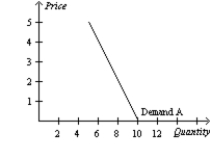
B) 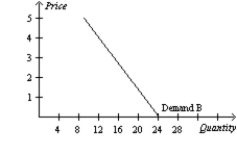
C) 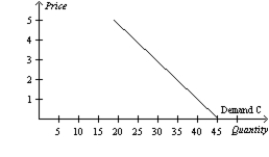
D) 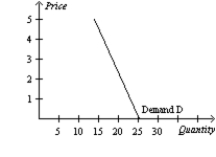
F) None of the above
Correct Answer
verified
Correct Answer
verified
A) price will increase.
B) price will decrease.
C) quantity may increase, decrease, or remain unchanged.
D) price may increase, decrease, or remain unchanged.
F) All of the above
Correct Answer
verified
Correct Answer
verified
A) A
B) B
C) C
D) D
F) A) and D)
Correct Answer
verified
Correct Answer
verified
A) 4 units.
B) 6 units.
C) 8 units.
D) 10 units.
F) A) and C)
Correct Answer
verified
Correct Answer
verified
A) luxury good.
B) inferior good.
C) normal good.
D) complementary good.
F) B) and C)
Correct Answer
verified
Correct Answer
verified
A) arbitrage.
B) monopolistic competition.
C) equilibrium.
D) perfect competition.
F) B) and D)
Correct Answer
verified
Correct Answer
verified
A) profit and quantity supplied.
B) quantity supplied and quantity demanded.
C) price and quantity supplied.
D) price and profit.
F) A) and C)
Correct Answer
verified
Correct Answer
verified
A) The goods offered for sale are exactly the same.
B) There are so many buyers and sellers that no single buyer or seller has any influence over the market price.
C) It is difficult for new sellers to enter the market.
D) Both a and b are correct.
F) A) and C)
Correct Answer
verified
Correct Answer
verified
A) Both the equilibrium price and quantity would increase.
B) Both the equilibrium price and quantity would decrease.
C) The equilibrium price would increase, and the equilibrium quantity would decrease.
D) The equilibrium price would decrease, and the equilibrium quantity would increase.
F) All of the above
Correct Answer
verified
Correct Answer
verified
Showing 401 - 420 of 697
Related Exams